
How to Strengthen Your Dog’s Spine and Keep Them Moving Strong
A healthy spine is at the core of your dog’s mobility, comfort, and overall well-being. Just like humans, dogs rely on a strong and flexible spine to walk, run, jump, and play. Over time, age, injury, or even day-to-day activities can lead to stiffness, weakness, or spinal imbalances that affect how your dog moves and feels.
The good news? There are simple things you can do at home to help support your dog’s spine and keep them strong and active for years to come.
Keep Them Moving — But Mindfully
Movement nourishes the spine. Regular, gentle exercise helps maintain flexibility, strength, and coordination.
- Take daily walks on even terrain to promote balanced movement.
- Include varied motion like slow uphill walks or figure-8 patterns to engage core stabilizer muscles.
- Avoid repetitive ball throwing or twisting jumps that can strain the back and neck.
 Tip: For senior dogs, multiple short walks are better than one long outing.
Support Core Strength
A strong core helps stabilize the spine and prevents injury. These easy home exercises build balance and deep spinal strength:
Sit-Stand-Down Sequence
This is one of the simplest and most effective ways to engage your dog’s core and spinal stabilizers.
How to do it:
Ask your dog to sit squarely — both hips and hocks tucked evenly.
- Cue a stand — encourage them to rise smoothly without stepping forward.
- Then gently cue a down (lie-down) position, again keeping it controlled.
- Repeat 3–5 times, encouraging slow, fluid transitions.
What it does: Works the abdominal and back muscles, improves coordination, and helps maintain mobility in the hips and lower back.
Leg Lifts
This gentle balance exercise engages spinal stabilizers and improves body awareness.
How to do it:
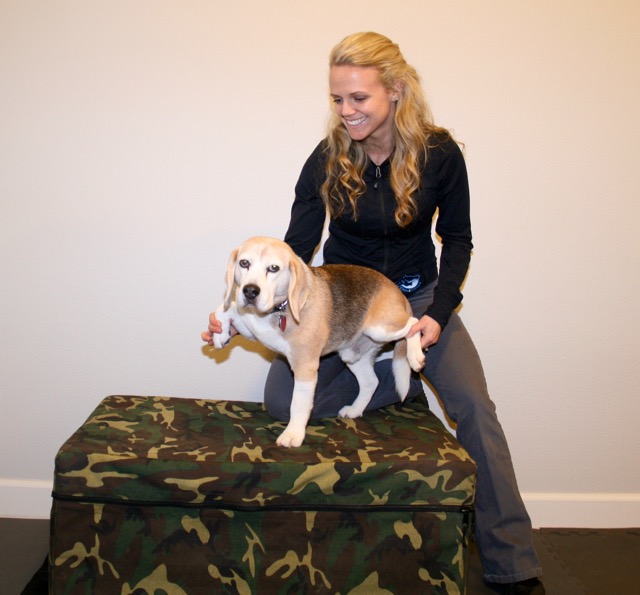
- Have your dog stand squarely.
- Gently lift one front paw just an inch or two off the ground and hold for 10-15 seconds.
- Lower it back down, then lift the opposite hind paw for 3–5 seconds.
- Repeat each leg 3–4 times. Eventually, increase duration to a 1-minute hold.
- Another challenge would be to hold one front paw and the opposite rear paw at the same time.
What it does: Strengthens the small stabilizing muscles along the spine and helps your dog learn to balance weight evenly — great for senior dogs or those recovering from injury.
Cavaletti Poles
Have your dog slowly step over low poles (or broomsticks) spaced a few feet apart (typically shoulder height of your dog).
What it does: Builds coordination, core strength, and rhythm through the spine and limbs.
Balance Work
Standing on an unstable surface (like a wobble pad or couch cushion) engages the deep spinal and core muscles that support posture. Start with 10–15 seconds and build gradually. You could also make this more challenging by lifting a paw while they balance on the pad.
Sit-to-Stand Repetitions
Encourage your dog to perform slow, controlled sits and stands — just like doggy squats.
What it does: Strengthens the hind end, engages the core, and helps maintain spinal alignment during transitions.
Maintain a Healthy Weight
Extra weight means extra pressure on your dog’s spine and joints.
You should be able to feel their ribs easily without pressing hard, and they should have a visible waistline from above. Maintaining a lean body condition is one of the simplest — yet most powerful — ways to prevent back pain and keep your dog mobile.
Regular Chiropractic Care
Just like in people, spinal misalignments can affect how well the body functions. Gentle animal chiropractic adjustments help:
- Restore normal motion in restricted joints
- Reduce pain and muscle tension
- Improve posture and flexibility
- Enhance nervous system function and body awareness
Routine chiropractic care allows early detection of changes in motion before they lead to bigger problems.
Provide a Supportive Environment
Little adjustments at home can go a long way:
- Use non-slip rugs or yoga mats on hardwood floors.
- Offer a firm, orthopedic bed that supports the spine.
- Use ramps or stairs to help your dog onto furniture or into the car if they struggle with hind end weakness.
These reduce unnecessary stress on the back — especially for aging or long-bodied dogs (like dachshunds or corgis).
The Bottom Line
Your dog’s spine is the foundation of their movement and vitality. With mindful exercise, healthy habits, and regular chiropractic care, you can help your best friend stay comfortable, balanced, and strong well into their senior years.
Recent Comments